
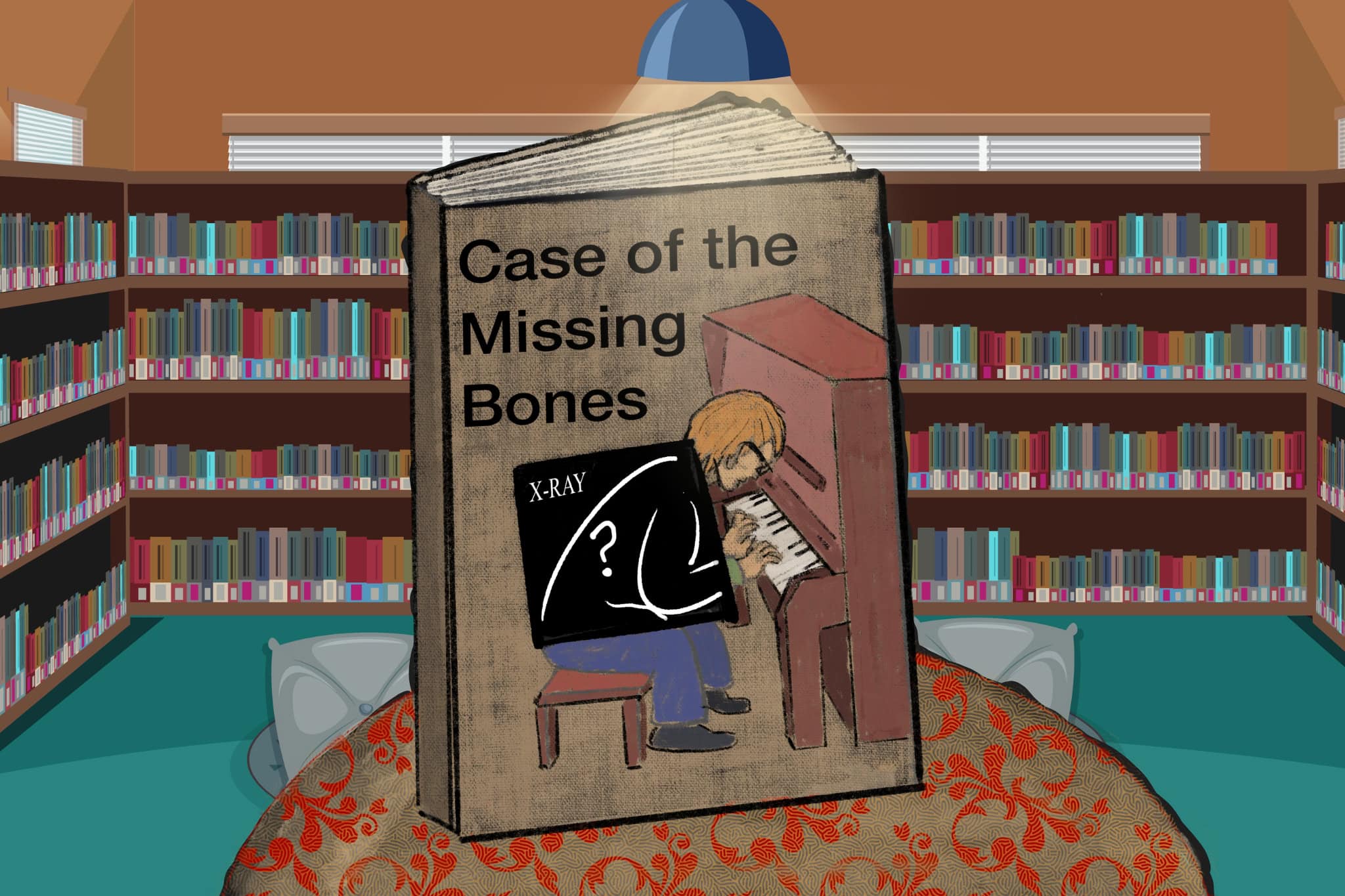
The Case of the Students without Bones
In the last few years, I have noticed multiple students playing piano with their elbows resting on their legs, backs curved into hunchback level Cs, and wrists placed at sharp angles exceeding 90 degrees so that their fingers can aim downwards to strike at the keys.
If that description causes you to wince, you aren’t alone. Every time I witness a student’s poor posture, my mind screams in pain. Honestly, I don’t know how they do it, but it has occurred to me that they might be missing bones.

Tech Is Leading to An Out-Of-Tune (spinal) Cord
There is much in our modern age that is contributing to poor posture among the majority of us. “Text Neck” is a big one we hear about as a result of our connection to our many devices. Smart phones and tablets require our gaze to aim downward with our arms resting comfortably in our laps or on a table or desk. Even laptops, in their smaller, thinner iterations, have our sights aimed low, unlike the desktop computers of days gone by.
It’s an amazing phenomenon given all the emphasis on ergonomics in the 90s. Remember the variety of monitor stands, split ergonomic keyboards, bulbous ergonomic computer mice, and wrist rests? (Oh, the wrist rests.) Seems like today the only ergonomic thing of importance is the gaming chair. (Ah, the gaming chair.)
The gaming chair is designed to keep you comfortable so you can remain seated to play video games for hours on end. And they’re not just for gamers! You can use one in your workplace too. Because it doesn’t matter what we do in our work or our daily routine, the vast majority of us spend our days seated, trapped in the glow of blue light from a screen. Welcome to the world of tomorrow!
The abundance of postural issues goes beyond piano. Today’s students lack strength to hold and support their beginning band instruments. We’ve discussed hand posture issues with woodwinds in the past. Body posture issues plague these students as well. They are increasingly dependent on the backs of their chairs to rest their arms or play their instruments while seated in a deep slouch. The situation begs the question, exactly how do we begin to correct these kinds of issues?
Facing the Music: Why a Straight Spine Rules
First and most importantly, we need to be excited about posture and why it’s important. Posture is the P in Performance! It conveys our readiness and attitude. Good alignment allows our body to function more efficiently and effortlessly while minimizing injury. When we use good posture, we look great. This naturally transfers to feeling great. Good posture can help our focus and ability to retain new information. It is our foundation for success in learning and skill-building.
Secondly, we need to acknowledge that improving posture is a team effort. The best we can do in lessons as instructors is to bring attention to the issue while encouraging the student to maintain good posture during their time with us. We also try to explain why good posture is important to the student and to their parents. But unless they are reminded to engage their core muscles throughout the week, it is a losing battle.
Tuning Up the Body
There have been efforts focused on schools to address these issues for some time now, from changing the ergonomics and seating choices within the classroom, to finding more opportunities to move, to reducing the weight of materials that travel back and forth with students in backpacks. There seems to be decent research on the topic with recommendations for schools to help students correct the issue. However, there are no standards for teaching good posture. It usually just ends up a footnote in physical education or health class at best.
While teachers may remind students to sit up straight, unless there is a “why” and regular reinforcement, this effort is ineffective at best. (And let’s be honest, teachers do not have the bandwidth to educate students on posture issues in today’s teaching environment.)
There are no easy answers to any of this. It is, however, important for music students to understand that good posture is essential to music learning and offers many benefits:
- Proper posture allows you to sit comfortably at the piano or in a chair for extended periods of time while practicing or performing.
- Aligning the body correctly optimizes breathing for playing wind instruments.
- Good posture improves focus, attentiveness, and mood in one’s music lessons to make learning easier.
- Sitting or standing tall alleviates muscle fatigue and tension buildup in the lower back and neck.
- A straight spine lowers cortisol levels and increases oxygen flow to the brain. This leads to better mental processing of complicated sheet music, which leads to better performances.
Harmonizing the Body and Mind
Once a student understands the benefits of good posture, there are several methods to maintain it that can be incorporated into a 5-minute prep-time practice you execute before every lesson or performance:
- Begin by grounding both feet flat on the floor to stabilize the lower body.
- Align your shoulders over your hips and concentrate on keeping the spine long but not rigid.
- Drop your shoulders, unclench your jaw, and shake out any hidden tension you may feel in your arms, wrists, and hands.
- Inhale for 4 beats, hold for 4 beats, and exhale steadily on a “hiss” sound for 4 beats. Repeat multiple times. This establishes a steady pulse and releases jaw tension.
- Allow your arms and hands to flow naturally to your instrument.
If you find you are truly struggling to maintain good posture, there are occupational therapy programs available that are specifically tailored to musicians.
Playing a musical instrument is just as physically taxing for musicians as sports are for athletes. Avoiding injury while participating at peak performance levels is critical to both. Maintaining good posture is one way to ensure long-lasting enjoyment and some spine-tingling performances.
Do you have any inspiring methods for maintaining good posture that you incorporate into your routine? Reach out and let us know. We’d love to hear from you!
 The Taylor Swift Conundrum